 blog
Which Insulation Is Best for a Small Backyard Dwelling?
Last Updated: November 12, 2026
Quick Summary
The best insulation for backyard dwellings is the material that reaches the required R-value inside a shallow 2x4 wall without adding weight or trapping moisture. Closed-cell spray foam suits thin cavities and air sealing, while cellulose is the standout eco-friendly pick for small dwellings. Match each material to your actual wall, roof, and climate zone rather than copying full-house practice.
- A 2x4 cavity holds roughly 3.5 inches of material, capping fiberglass batts near R13.
- Closed-cell spray foam delivers about R-6 to R-7 per inch in thin cavities.
- A 2025 F1000Research study recommends cellulose as a sustainable choice for tiny houses.
- Air sealing comes before insulation, always, because leaks move more heat than extra R-value recovers.
- QuiPlans provides PE-stamped drawings from licensed structural engineers in 26 U.S. states.
Table of Contents
- Why Small Backyard Dwellings Need Different Insulation
- Quick Comparison: 7 Insulation Materials at a Glance
- The Best Type of Insulation for Walls in a Compact Dwelling
- Insulation for Attics and Cathedral Ceilings
- Eco-Friendly Insulation Materials Worth the Trade-Offs
- A Full Thermal Insulation Materials List, Ranked by R-Value per Inch
- Moisture, Vapor Barriers, and Indoor Air Quality
- Get Your Insulation Spec Into Permit-Ready Plans
- Frequently Asked Questions
Why Small Backyard Dwellings Need Different Insulation
A backyard dwelling is not a scaled-down house, and insulation for backyard dwellings that copies full-house practice wastes money. According to ENERGY STAR's recommended home insulation R-values, Zones 4A and 4B call for R10 insulative wall sheathing or R13 batt insulation, while Zones 4C and 5 through 8 require R15 sheathing or R19 batts. The code target is achievable, but only if the material fits the cavity.
That is the whole problem in one sentence. The best insulation for backyard dwellings is the material that hits the required R-value inside a shallow 2x4 wall without adding weight or trapping moisture.
The Three Constraints: Wall Depth, Weight, and Moisture
Three constraints separate a backyard dwelling from a full house. Wall depth comes first, because a 2x4 cavity holds roughly 3.5 inches of material, which caps fiberglass batts near R13. Weight matters for any unit built on a trailer or pier foundation, where every pound of wall assembly counts against the tow rating or the footing design. Moisture decides durability, since a small volume of air reaches dew point fast and condensation lands on the first cold surface it finds.
Miss any one of these and the assembly underperforms its label. For the full build sequence around these decisions, see our guide to the steps to build a backyard ADU.
Quick Comparison: 7 Insulation Materials at a Glance
Seven materials cover nearly every compact dwelling wall, and the table below shows where each one earns its place.
| Material | R-Value per Inch | Best For | Main Trade-Off |
|---|---|---|---|
| Closed-cell spray foam | About R-6 to R-7 | Thin cavities, air sealing | Cost, off-gassing during install |
| Open-cell spray foam | About R-3.5 | Irregular framing | Lower R per inch |
| Rigid foam board | R-4 to R-6.5 | Exterior sheathing | seams need taping |
| Mineral wool batts | About R-4.2 | Fire resistance, sound | Heavier, pricier than fiberglass |
| Fiberglass batts | About R-3.2 | Budget builds | Air leaks if poorly fitted |
| Cellulose | About R-3.5 | Dense-pack retrofits | Settles if not packed |
| Aerogel | Up to R-10 | Ultra-thin profiles | Highest cost per square foot |
Read the table as a starting filter, not a verdict. The right column matters as much as the R-value column.
The Best Type of Insulation for Walls in a Compact Dwelling
Each insulation option solves a different constraint, so match the material to the wall you actually have.
Closed-Cell vs. Open-Cell Spray Foam
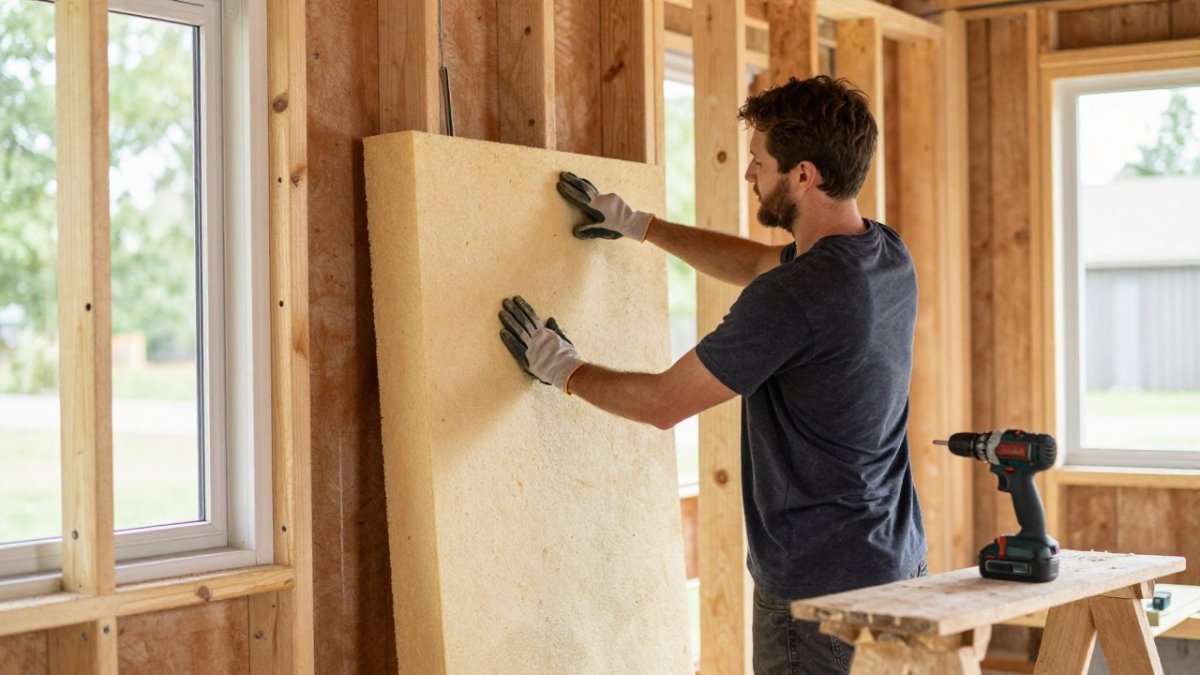
Closed-cell foam packs a higher R-value into less depth than open-cell foam, which costs less and fills odd framing bays well but delivers a lower R-value per inch. One caution from Mr. Hemp House's analysis of spray foam in small spaces: confined installs carry real off-gassing and ventilation risk, so small dwellings need a contractor who plans air movement during curing.
Rigid Foam Board and Mineral Wool Batts
Rigid board goes on the outside of the studs, adding continuous R-value and breaking thermal bridging at the framing. Mineral wool batts fill the cavity and hold their shape through fire exposure better than foam. Used together, they form a thermal envelope that performs above its nominal numbers.
Insulation for Attics and Cathedral Ceilings
Attic insulation for a small dwelling follows a different rule than wall insulation: depth is usually available, so blown insulation can be an economical option. Cathedral ceilings are the exception, because the rafter depth limits what fits. There, rigid foam board under the deck or closed-cell foam between rafters preserves headroom while meeting the target.
Ventilation decides whether either approach survives. A sealed, unvented roof assembly needs the dew point kept on the warm side of the insulation, and that calculation belongs in the plans, not on the job site.
Eco-Friendly Insulation Materials Worth the Trade-Offs
Cellulose is the standout eco-friendly insulation material for small dwellings, and the reason is a combination of performance and fit. A 2025 study in F1000Research on insulation in tiny houses found cellulose delivers strong thermal performance and recommends it as a sustainable choice for small-scale residential construction.
The trade-offs are real, though, and they matter more in a compact footprint than in a full house. Cellulose settles over time if it is not packed to the correct density, so a loose blow-in job loses R-value at the top of the cavity.
Other natural options trade performance for story, and the numbers decide whether the trade is worth it. Wood fiber offers an R-value around 2.5 per inch, cork boards reach about 3.5, and Foamglas sits near 3.4, according to The Mud Home's natural insulation comparison. Those numbers mean thicker walls for the same R-value, which is a hard sell in a compact footprint where every inch of wall depth is contested.
Two factors deserve a place in the comparison. First, fire safety: mineral wool and cellulose are both non-combustible or fire-retardant treated, while many foam products require an ignition barrier or a thermal barrier under the building code. Second, off-gassing and indoor air quality: natural fiber materials like cellulose, wood fiber, and cork generally have lower VOC profiles than spray foams, which is a meaningful advantage in a small, high-surface-area-to-volume space.
Weight is the third trade-off, and it is the one most guides ignore. Small backyard dwellings are often built on trailers or skids, and every pound of wall assembly counts against the tow rating or the footing design. Cellulose is heavier per unit of R than fiberglass or foam, wood fiber is heavier still, and aerogel, while the lightest per unit of R, is priced out of whole-wall coverage.
Watch out: choosing an eco-material for the label alone, without checking its thickness penalty, moisture behavior, and fire rating against the specific wall and site, is how a sustainable choice becomes an expensive re-do.
A Full Thermal Insulation Materials List, Ranked by R-Value per Inch
Here is the thermal insulation materials list ranked by R-value per inch, highest first: aerogel, closed-cell spray foam, rigid foam board, mineral wool, open-cell spray foam, cellulose, fiberglass, then the natural materials. Aerogel leads at up to R-10 per inch, per Lone Star Insulation's 2026 material comparison, but its cost rules it out for whole-wall coverage in most projects.
Rank order is not the same as best choice. A material ranked sixth can still be the right answer for a budget wall in a mild climate.
To turn this ranking into quantities and cost for your own plan, use our material estimate tool.
Moisture, Vapor Barriers, and Indoor Air Quality
Moisture management decides whether an insulation choice lasts, and in a small dwelling the margin for error is thinner than in a full house. The reason is physics: a compact volume of warm, moist indoor air reaches its dew point faster and deposits condensation on the first cold surface it touches, usually the back of the exterior sheathing or the face of the insulation itself. Once that surface stays wet, mold colonizes within days, and you cannot see it because it sits behind drywall.
The mechanism to understand is the dew point. Warm air holds more moisture than cold air; as it cools against a cold surface, it releases that moisture as liquid water. The location where the air temperature drops to the dew point is called the condensation plane, and the entire job of a vapor barrier is to keep that plane on the warm side of the insulation. Put the barrier on the wrong side and you can move the condensation plane into the wall cavity.
Placement depends on climate zone, not habit. Vapor retarder placement depends on climate zone, and the International Residential Code sets class requirements by climate zone. Plan reviewers check the code requirements against the drawings.
Air sealing comes before insulation, always. Gaps at outlets, top plates, rim joists, and window rough openings move more heat and more moisture-laden air than an extra inch of R-value recovers. In a small dwelling the surface-area-to-volume ratio is high, so every leak matters more. Seal first, then insulate, then verify the vapor retarder is continuous and lapped correctly at penetrations.
Indoor air quality is the second half of the problem. Small spaces concentrate whatever off-gasses, and spray foams, sealants, and some rigid boards emit volatile organic compounds (VOCs) during and after cure. Closed-cell spray foam in particular needs a cure period before occupancy, and the manufacturer's cure schedule should be treated as a minimum, not a target.
Watch out: skipping the dew-point and vapor-retarder analysis to save a step is the single most expensive shortcut in a compact build, because the failure mode is invisible until the wall is already compromised.
Get Your Insulation Spec Into Permit-Ready Plans
An insulation specification only counts once it survives plan review. A permit-ready engineering package should show the assembly, the R-value per component, and the vapor barrier location, all consistent with the climate zone on the drawings. Reviewers reject plans for missing or contradictory envelope details more often than for the material chosen, and our breakdown of why city inspectors reject engineering plans covers the recurring causes.
QuiPlans provides PE-stamped drawings from licensed structural engineers in 26 U.S. states, with instant downloads and feasibility studies, and is trusted by over 7,000 homeowners. You can review what the engineering package includes, then order permit-ready plans with your insulation spec built in.
Insulation choices are easy to make and hard to change once the drywall closes. The right next step is getting your assembly, R-values, and vapor barrier onto drawings a reviewer will approve. QuiPlans delivers PE-stamped plans, licensed structural engineers in 26 states, and feasibility studies that catch envelope problems before they cost you a revision cycle. Get started with QuiPlans and build a backyard dwelling that passes review the first time.
Frequently Asked Questions
What is the best insulation for a small backyard dwelling?
There is no single winner, because the right pick depends on wall depth and climate zone. Closed-cell spray foam delivers the highest R-value per inch and doubles as a vapor barrier, which suits thin 2x4 walls. Rigid foam board can be a practical choice when a shallow cavity limits how much insulation fits. Mineral wool batts work well where fire resistance matters. Match the material to your climate zone requirement first, then to the space you have.
Is spray foam or fiberglass better for a small dwelling?
Spray foam wins on performance per inch and air sealing, but it carries real risks in tight spaces. Off-gassing during installation requires strong ventilation, and confined crawl spaces make that harder. Fiberglass batts cost less and install without chemical curing, but they need a deeper cavity to hit the same R-value and perform poorly if air moves through them. For a compact dwelling with 2x4 walls, closed-cell foam usually makes more sense.
How much insulation does a backyard dwelling need?
Follow the climate zone targets rather than guessing. Insulation targets vary by climate zone, so check the required R-values for your zone before you finalize the design. Attics typically need more than walls. Because a small dwelling has a high surface-area-to-volume ratio, it loses heat faster per square foot than a full house, so hitting the top of your zone's range pays off. Your permit drawings should state the target R-value explicitly.
Can natural insulation materials be used in a small home?
Yes, with caveats. Natural materials such as cellulose can be considered for small construction, but many offer lower R-value per inch than foam, so they often need thicker assemblies. Natural materials suit owner-builders who prioritize low embodied carbon and are willing to trade wall thickness for it.