 ultimate-guide
Multigenerational Living Best Practices for 2026
Table of Contents
- Why Multigenerational Living Is on the Rise
- Start with a Shared Vision and House Rules
- Designing ADU Floor Plans for Aging in Place
- Privacy Solutions for Shared Living Spaces
- Navigating Zoning Laws for Accessory Dwelling Units
- Financial Planning and Cost-Sharing That Works
- Communication Strategies for Long-Term Harmony
- Conclusion: Build a Home That Grows with Your Family
- Frequently Asked Questions
Last Updated: September 5, 2026
Why Multigenerational Living Is on the Rise
Multigenerational living, where grandparents, parents, and children share one household, is one of the fastest-growing housing arrangements in the United States, driven by rising elder care costs, shared childcare benefits, and the desire to stay close as a family. At QuiPlans, we've helped thousands of homeowners navigate this transition, and the single most important lesson is this: success depends far less on the size of your home than on the quality of your planning.
Families are discovering that multigenerational living can ease financial strain while strengthening family bonds. When adult children return home to care for aging parents, or when young families move in to save for a down payment, everyone contributes something valuable, income, childcare, or household chores. This arrangement also supports independent living for seniors who want to avoid institutional care while staying connected to their support system.
Below, we'll walk through practical strategies that turn a crowded house into a harmonious shared living space, from ADU floor plans for aging in place to communication frameworks that prevent small disagreements from becoming family feuds.
Start with a Shared Vision and House Rules
Before you measure a single wall, gather every household member and define what success looks like for your family. A shared vision prevents the most common source of conflict in multigenerational homes: mismatched expectations about daily life.
Write down house rules that address the friction points most families encounter. Who manages the groceries? What are quiet hours for the grandparents? How do you handle visitors in common areas? Documenting these agreements creates accountability without requiring anyone to be the "bad guy" later.
Practical framework for your first family meeting:
- Each adult lists their top three non-negotiables
- Identify where those lists conflict and negotiate compromises
- Assign recurring household responsibilities with clear ownership
- Schedule a monthly check-in to revisit what is and is not working
A common mistake is treating this as a one-time conversation. Family dynamics shift as children grow, jobs change, and health needs evolve, so your house rules should be living documents reviewed regularly.
Designing ADU Floor Plans for Aging in Place
Accessory dwelling units (ADUs) have become the preferred solution for families who want proximity without sacrificing privacy. A well-designed ADU gives aging parents their own entrance, kitchen, and living space while keeping them minutes from family support.
Aging in place means designing for the future, not just the present. The best ADU floor plans incorporate accessibility modifications from the start, zero-threshold entries, 36-inch doorways for mobility devices, and a bedroom and full bath on the main level, because retrofitting later costs significantly more.
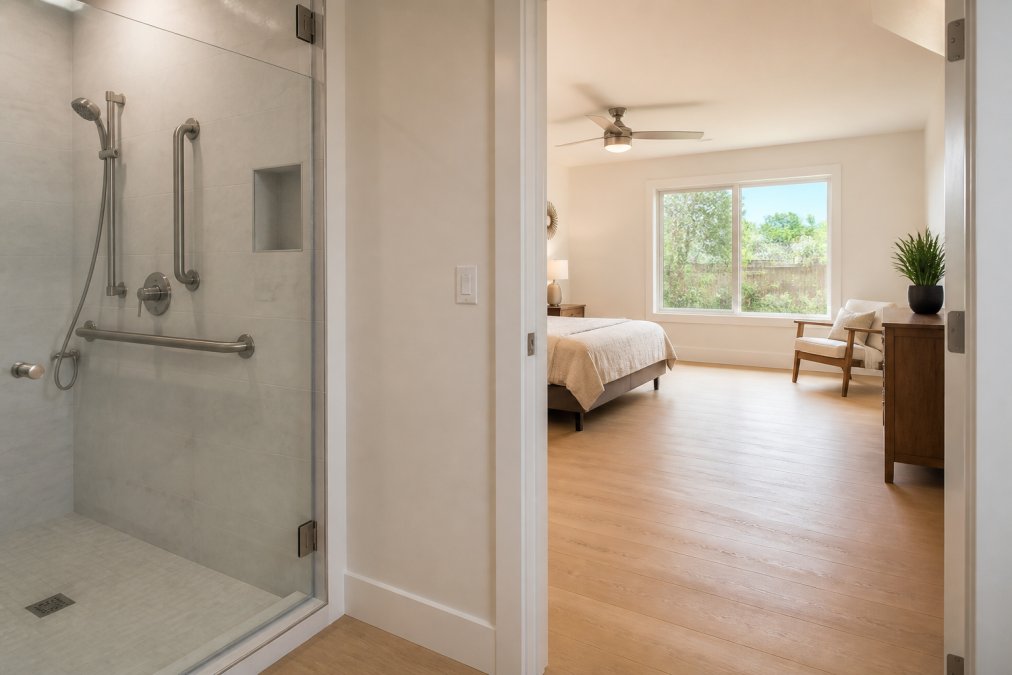
Universal design principles benefit every generation, not just seniors. Wider hallways ease furniture moves, lever-style handles help a child carrying groceries and an adult with arthritis, and task lighting addresses age-related vision challenges. These features also increase property value, making your ADU a sound investment regardless of who lives in it.
For new construction, permit-ready plans from licensed structural engineers simplify the approval process and prevent delays from incomplete drawings.
Privacy Solutions for Shared Living Spaces
The tension between togetherness and privacy is the defining challenge of multigenerational living. Even the closest families need personal space, and the lack of it is the top reason these arrangements fail.
Smart floor plan design solves most privacy problems before they start. A separate entrance for the ADU or in-law suite creates genuine independence, and soundproofing between shared walls reduces the friction of different daily rhythms, a grandparent who wakes at 5 AM should not disturb a grandchild who studies until midnight.
Effective privacy strategies by space type:
- Bedrooms: Lockable doors are non-negotiable for every adult
- Bathrooms: Schedule peak usage times; consider a second half-bath if feasible
- Common areas: Define which spaces are shared and which are reserved
- Outdoor zones: A small private patio or garden entrance gives seniors fresh air without navigating the main house
Technology also supports privacy. Smart locks allow each adult to control access to their suite, and separate Wi-Fi networks give younger members autonomy while letting parents manage screen time, small boundaries that preserve autonomy while keeping the household connected.
Navigating Zoning Laws for Accessory Dwelling Units
The legal landscape for ADUs has shifted dramatically in recent years, and understanding your local zoning laws determines whether your project is feasible at all. Many states have passed legislation limiting local restrictions on ADU construction, recognizing them as a critical tool for housing affordability.
Before falling in love with a floor plan, verify three things with your local planning department: minimum lot size requirements, maximum ADU square footage, and setback rules. Some jurisdictions also impose owner-occupancy requirements, meaning the owner must live in either the main house or the ADU.
A feasibility study conducted early in the process saves substantial time and money. Professional services that include zoning analysis identify potential obstacles before you invest in detailed architectural drawings. This is where working with a provider experienced across multiple jurisdictions pays off, since common pitfalls vary widely between municipalities. According to the American Planning Association's housing policy resources, local zoning codes are the single largest determinant of whether an ADU project moves forward.
Financial Planning and Cost-Sharing That Works
Money is the most sensitive topic in any family, and multigenerational households need explicit financial agreements to thrive. Each adult's contribution should reflect their income, not an equal split, and this must be discussed openly from the start.
A practical cost-sharing model:
- Calculate total monthly housing costs, including mortgage, utilities, and groceries
- Divide by total household income to find each adult's proportional share
- Revisit the formula annually or when income changes
- Document the agreement in writing to prevent future disputes
Beyond monthly expenses, plan for major repairs and future care needs. An aging parent may need increasing levels of care, and understanding those costs in advance prevents crisis decisions. The National Endowment for Financial Education's household research emphasizes that families who discuss finances before moving in together report significantly lower stress than those who improvise.
Homeowners should also consider how an ADU affects property taxes and insurance. The added square footage typically increases assessed value, though some jurisdictions offer exemptions for family-occupied ADUs. A conversation with your insurance agent about multi-resident coverage ensures your investment is properly protected.
The Legal Side of Shared Finances Most Guides Miss
Most multigenerational living advice stops at budgeting, but the legal structure of your financial arrangement determines whether your family is protected if circumstances change. Three legal instruments deserve attention before anyone writes a monthly check.
Property title structures. If an adult child contributes financially to a home purchase or major renovation, the title structure matters. Joint tenancy with right of survivorship means the property passes automatically to the surviving owner, avoiding probate. Tenancy in common allows each owner to sell or bequeath their share independently, which offers more flexibility but less automatic protection. A common pattern is for aging parents to add an adult child to the deed in exchange for care commitments, but this can trigger gift tax implications and complicate Medicaid eligibility if the parent later needs long-term care. The National Academy of Elder Law Attorneys' consumer resources recommends consulting an elder law attorney before changing any property title, because the five-year look-back period for Medicaid can penalize asset transfers made too late.
Power of attorney and healthcare directives. Every adult in the household should have a durable power of attorney naming someone to handle financial decisions if they become incapacitated, plus a healthcare proxy for medical decisions. This is not about the oldest generation only. A working parent with young children needs the same protections as a grandparent. Without these documents, family members may face court proceedings to gain authority over a relative's affairs, which is costly and slow. The American Bar Association's consumer's guide to advance directives provides state-specific forms that families can complete without an attorney, though a lawyer's review is advisable when property is involved.
Care cost agreements. When one generation provides care for another, a formal care agreement protects both sides. The care recipient pays the caregiver a documented rate for services, structured as a legitimate expense rather than a gift. This preserves the caregiver's Social Security and Medicare eligibility and creates a paper trail satisfying Medicaid's documentation requirements. A written agreement should specify services, compensation rate, and payment schedule, with most practitioners recommending a rate at or below fair market value, typically $15 to $30 per hour depending on care level.
The Hidden Tax Implications of Shared Housing
The IRS treats rental income from an ADU as taxable, with one meaningful exception: if you rent to a family member at below fair market rent, you generally do not need to report the income, but you also cannot deduct related expenses. This "family discount" arrangement simplifies taxes but forfeits depreciation benefits. Families who charge fair market rent can claim deductions for mortgage interest, property taxes, maintenance, and depreciation, which often offsets most rental income, but the income must be reported and documented with a formal lease.
Property tax assessments also change when you add an ADU. Many jurisdictions reassess upon completion of new construction, which can increase your tax bill significantly. However, some states, including California under Proposition 19, cap the assessment increase for ADUs added to an existing primary residence. Check with your county assessor's office about exemptions for family-occupied ADUs before finalizing your budget.
A final consideration is long-term care planning. If an aging parent contributes a lump sum to a renovation or purchase, that transfer may affect their Medicaid eligibility for nursing home care later. The five-year look-back period means any transfer made within five years of applying can trigger a penalty. An elder law attorney can structure contributions as loans rather than gifts, with a promissory note that protects the family's investment while preserving Medicaid eligibility.
Communication Strategies for Long-Term Harmony
Strong communication is the foundation of every successful multigenerational household. Families who thrive build intentional systems for addressing conflict before it escalates.
Schedule a standing family meeting, weekly or monthly, where anyone can raise concerns without defensiveness. Use a simple framework: state the issue factually, explain how it affects you, propose a specific change, and invite the other person's perspective. This structure prevents conversations from becoming personal attacks.
Cultural perspectives shape how families approach these conversations. In many traditions, caring for elders at home is an expected responsibility, not a lifestyle choice. Honoring those values while establishing modern boundaries around privacy and autonomy respects both heritage and individual needs.
The reality is that conflict is inevitable in any household sharing space, finances, and daily life. The goal is not to eliminate disagreement but to create a safe process for working through it. As documented in Generations United's research on intergenerational households, families that communicate proactively report stronger bonds and greater satisfaction with their living arrangement.
A Step-by-Step Mediation Framework for Family Disputes
Most communication advice stops at "talk it out," but families need a repeatable process when emotions run high. The following framework, adapted from family mediation practices, gives every household member a structured path from conflict to resolution.
Step 1: The 24-hour cooling-off rule. When a conflict arises, no one addresses it in the moment. Instead, the person who feels wronged requests a family meeting within 24 hours, preventing reactive statements that escalate tension. The rule applies equally to grandparents and teenagers, establishing that every concern deserves a hearing.
Step 2: The speaker-listener technique. During the meeting, only one person speaks at a time. The speaker states their concern using "I" statements, describing the specific behavior and its impact, for example, "I feel frustrated when the kitchen is left messy after dinner because I need to prepare breakfast early." The listener paraphrases what they heard without defending themselves and confirms the paraphrase is accurate before responding. This technique, drawn from marriage and family therapy research, reduces defensiveness by forcing active listening before rebuttal.
Step 3: Identify the underlying need. After both parties have spoken, the group identifies the underlying need behind each position. The kitchen complaint is not about cleanliness but a predictable morning routine; the teenager leaving dishes needs unstructured evening time after homework. Naming the underlying need transforms the conversation from blame to problem-solving.
Step 4: Brainstorm three options. Each party proposes at least three potential solutions without evaluating them, quantity matters more than quality. Options might include a rotating cleaning schedule, designated personal dishes, or a rule that everyone cleans their own items immediately. The goal is to generate possibilities neither party would have considered alone.
Step 5: Agree on a trial period. The family selects one solution and agrees to try it for two weeks. The solution must be specific, measurable, and time-bound. "Clean the kitchen" is too vague. "Each person washes their own dishes and wipes the counter immediately after use" is actionable. The trial period removes the pressure of permanence and allows for adjustment.
Step 6: The follow-up check-in. At the next scheduled family meeting, the group evaluates the trial. If the solution worked, it becomes a permanent house rule; if it failed, the family returns to Step 4 and generates new options. This iterative process normalizes revision and prevents the shame of "failing" at a solution.
Technology as a Communication and Privacy Tool
Digital tools can reduce friction in multigenerational households when deployed thoughtfully. A shared family calendar app, such as Cozi or Google Calendar, coordinates appointments, meal planning, and childcare schedules without verbal coordination. Each adult maintains their own color-coded calendar, and the household view shows the full picture at a glance.
For households with aging parents, a simple group messaging thread serves as a low-pressure communication channel for updates, help, and logistics without interrupting each other's work or rest. The key is establishing norms around response times, a grandparent should not feel ignored if a text goes unanswered for hours, and younger members should not feel monitored if they decline to respond immediately.
Smart home technology also supports privacy boundaries. Separate Wi-Fi networks prevent bandwidth conflicts and give each adult control over their own digital space. Smart locks with individual codes allow each person to enter their own suite without physical keys, and codes can be changed instantly if shared unintentionally. Video doorbells at separate entrances reduce the anxiety of unexpected visitors and give each generation control over their own front door.
The most important technology rule is that devices support human connection rather than replace it. A family that texts instead of talking still needs the monthly meeting. Technology works best when it handles logistics, freeing up face-to-face time for conversations that build trust and understanding.
Conclusion: Build a Home That Grows with Your Family
Successful multigenerational living requires intentional planning across every dimension: physical space, financial agreements, and family communication. Families who invest time in these conversations before moving in together consistently report better outcomes than those who hope things will work out.
Start with a professional home assessment of your current property to determine whether an ADU addition or a remodel of your existing floor plan better serves your family's needs. Then secure the engineering and permit-ready plans that keep your project moving through approval without costly revisions.
At QuiPlans, we provide PE-stamped drawings from licensed structural engineers across 26 states, trusted by over 7,000 homeowners to deliver the technical expertise that turns multigenerational living from a dream into a permit-approved reality. Our feasibility studies and construction administration support guide you from concept to completion.
Get started with QuiPlans and build a home designed for every generation of your family.
Frequently Asked Questions
What are the primary challenges of living in a multigenerational household?
The main challenges are privacy, differing expectations around household chores, financial contributions, and caregiving responsibilities. Many families also struggle with adapting a home that was not designed for multiple adults. Clear house rules, dedicated personal spaces, and an ADU with a separate entrance can reduce friction. Planning communication strategies early, before moving in together, prevents small disagreements from becoming larger conflicts.
How does zoning affect my plans to build an ADU for family?
Zoning laws for accessory dwelling units vary by city and county. They govern setbacks, maximum building size, parking requirements, and owner-occupancy rules. Before ordering plans, check your local municipal code or zoning ordinance. Some jurisdictions have relaxed restrictions in recent years, but you still need a permit. QuiPlans provides feasibility studies and PE-stamped drawings that meet code in 26 states, helping you navigate the approval process with fewer delays.
What are the best privacy solutions for shared living?
Effective privacy solutions for shared living start with the floor plan. A separate entrance, a lockable interior door, and a private bathroom give adult children or aging parents independence. Soundproofing interior walls and placing bedrooms on opposite sides of the home reduces noise. For existing homes, converting a basement or adding an ADU creates the physical separation most families need. QuiPlans can help you evaluate which option fits your property.
How do I finance an ADU for a multigenerational setup?
Homeowners typically use cash, a home equity line of credit, a cash-out refinance, or an FHA 203(k) renovation loan. Some states and localities offer grants for aging in place modifications. Before committing, get a detailed cost estimate from a contractor and compare it against the projected increase in property value. QuiPlans provides feasibility studies that help you understand the scope and budget before you engage a lender.