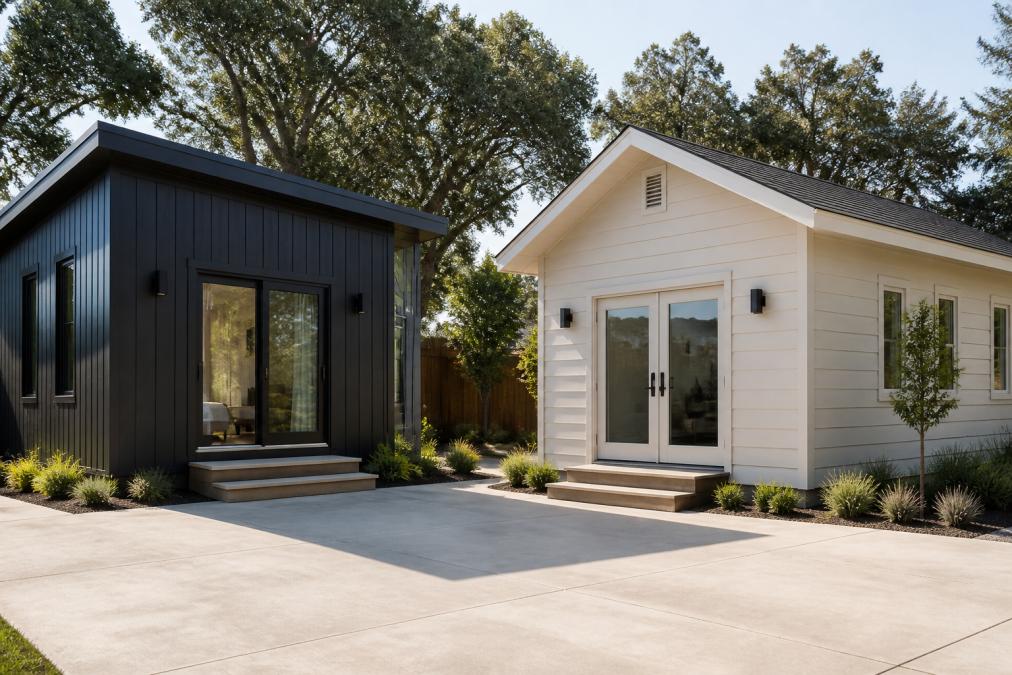
 comparison
IMKAT Homes vs Snap ADU: Which ADU Builder Wins?
Table of Contents
- IMKAT Homes vs Snap ADU: Quick Comparison
- How We Evaluated These ADU Builders
- IMKAT Homes: Full-Service Custom Construction
- Snap ADU: Prefab and Fixed-Price Models
- Steps to Build a Backyard ADU with Either Builder
- Average Cost of an ADU in California
- ADU Permit Requirements in California
- Financing Options and Long-Term ROI
- Frequently Asked Questions
Last Updated: September 16, 2026
IMKAT Homes vs Snap ADU: Quick Comparison
Choosing between IMKAT Homes and Snap ADU comes down to one question: custom-built or prefabricated? IMKAT Homes is a full-service ADU builder specializing in custom floor plans from 462 to 1,200 square feet. Snap ADU takes the prefab route, emphasizing fixed-price packages and faster on-site assembly. This guide from QuiPlans breaks down both so you can pick the right ADU builder.

| Factor | IMKAT Homes | Snap ADU |
|---|---|---|
| Build Type | Custom site-built | Prefabricated / panelized |
| Floor Plans | 1-3 bedroom, plus duplex options | Studio through larger multi-room units |
| Pricing Model | Project-based contract, cost-plus or fixed bid depending on scope | Fixed-price package with defined inclusions |
| Typical Cost Range | Custom site-built ADUs commonly land in the $150,000-$300,000+ range depending on size and finishes | Prefab packages carry a higher entry-level price for larger units; smaller modular alternatives start lower |
| Timeline | Standard custom build, longer design and permitting phase | Faster on-site assembly once the unit is fabricated and delivered |
| Design Flexibility | High, plans drawn to your lot, setbacks, and layout | Moderate, preset configurations with limited structural changes |
| Permitting Support | In-house handling of JADU/ADU regulatory requirements | End-to-end project management including permitting |
| Site Work | Builder coordinates foundation, utilities, and site prep | Site prep and foundation still require separate coordination |
| Warranty | Confirm in writing, custom builders vary widely on structural vs. finish coverage | Confirm in writing, prefab warranties often split between factory and installer |
| Best For | Custom designs, turnkey service, unusual lots | Predictable budgets, speed, straightforward lots |
How to Read This Comparison
Three rows deserve extra attention because they are where homeowners most often get surprised:
- Pricing model. A project-based contract lets you change scope, but the final number can move. A fixed-price package locks the number and the design with it. Neither is inherently better, they shift risk to different parties.
- Site work. Prefab is not plug-and-play. Foundation, trenching, and utility connections are almost always separate line items, and on sloped or tight lots those costs can rival the unit itself.
- Warranty. Ask for the warranty document, not a verbal summary. Confirm what is covered (structural, envelope, systems, finishes), for how long, and who honors it, the factory, the installer, or the general contractor.
How We Evaluated These ADU Builders
We scored both builders on five criteria: construction quality, pricing transparency, project management depth, design flexibility, and permitting support.
IMKAT Homes: Full-Service Custom Construction
IMKAT Homes handles everything from design through final inspection, building custom floor plans including 1, 2, and 3-bedroom layouts and duplex options, with full-service project management that minimizes homeowner involvement.
IMKAT Homes Pros and Cons
Pros:
- High-quality construction
- Comprehensive service covering the entire building process
- Custom floor plans tailored to your lot and needs
- Experience navigating JADU and ADU regulations
Cons:
- ADU construction costs can be substantial
- Less budget certainty than fixed-price alternatives
- Longer timeline than prefab options
Snap ADU: Prefab and Fixed-Price Models
Snap ADU offers prefabricated units designed for faster on-site assembly, emphasizing fixed-price packages that reduce budget uncertainty, with floor plans ranging from studios to larger units.
Snap ADU Pros and Cons
Pros:
- Predictable pricing structure
- Reduced construction time compared to traditional custom builds
- Multiple floor plan options
- End-to-end project management including permitting
Cons:
- Entry-level price point may be higher compared to some custom builders
- Limited design customization compared to site-built options
- Site preparation and foundation work still require separate coordination
Steps to Build a Backyard ADU with Either Builder
Building a backyard ADU follows the same core sequence regardless of builder. The difference lies in who handles each step and how long it takes.
- Verify zoning and lot feasibility. Check local ordinances for setback requirements, lot coverage limits, and height restrictions. A feasibility study identifies problems before you commit.
- Select your builder and design. Custom builders like IMKAT Homes develop plans from scratch. Prefab companies like Snap ADU offer preset configurations.
- Commission architectural and structural plans. Your plans must meet building codes and include structural engineering calculations. QuiPlans provides PE-stamped drawings from licensed structural engineers across 26 states.
- Submit for permits. The permitting process varies by jurisdiction. Expect plan review, possible corrections, and inspection scheduling.
- Prepare the site. Foundation work, utility connections, and site survey come before construction begins.
- Construct the unit. Custom builds take longer. Prefab units assemble faster once delivered.
- Pass final inspections and connect utilities. Your general contractor coordinates this phase.
Average Cost of an ADU in California
ADU costs vary widely by size, type, and finishes. Custom site-built units often have a broad cost range. Prefab options may carry higher entry-level pricing for larger units, while modular structures can start lower for smaller configurations.
Several factors drive the final number:
- Square footage: Larger units cost more per project, though cost per square foot often decreases.
- Foundation type: Slab, crawl space, or pier foundations carry different costs.
- Utility connections: Distance from existing lines affects trenching and connection expenses.
- Site conditions: Sloped lots, poor soil, or limited access increase preparation costs.
- Finish level: Standard finishes versus custom selections change the bottom line significantly.
ADU Permit Requirements in California
California has some of the most permissive ADU legislation in the country, but local ordinances still govern the details. State law requires local agencies to approve ADUs meeting specific size, setback, and height standards, but cities and counties add their own requirements on top.
Key requirements to expect:
- Building permits: Required for all ADU construction, including prefab units.
- Zoning regulations: Setbacks, lot coverage, and height limits vary by jurisdiction.
- Site survey: Many jurisdictions require a current survey showing property lines and existing structures.
- Structural engineering: Plans must include calculations stamped by a licensed engineer.
- Utility connections: Separate utility meters may be required for rental units.
Financing Options and Long-Term ROI
Financing an ADU typically involves one of several paths, and the right one depends on how much equity you have, whether you need funds before or after construction, and whether you plan to rent the unit. This is the section most ADU comparison articles skip, and it usually decides whether a project happens at all.
The Main Financing Paths
- Home equity line of credit (HELOC). A revolving line secured by your home's equity. You draw as you build, keeping interest low during design and permitting. Variable rates mean your payment moves with the market. Best with substantial equity and tolerance for rate risk.
- Cash-out refinance. Replaces your existing mortgage with a larger one and hands you the difference in cash. Fixed rate, predictable payment, but you reset your entire mortgage and pay closing costs again. Best when current rates are at or below your existing rate.
- Construction loan. Short-term, interest-only during the build, then converts or is paid off at completion. Lenders disburse in draws tied to inspection milestones. Higher rates and more paperwork, but it does not require the cash to already sit in equity.
- Renovation or improvement loans. Some lenders offer products specifically structured for home additions, including ADUs, with terms between a HELOC and a construction loan. Availability varies by lender and state.
- FHA-backed options. For eligible properties, FHA financing can include ADU construction in certain loan programs. Eligibility rules are strict and vary, so confirm with a HUD-approved lender before assuming you qualify.
According to Fannie Mae ADU financing guidance, lenders increasingly recognize ADU rental income in borrower qualification, which changes the math on affordability for many homeowners. In practice, that means a documented, permitted ADU with a signed lease can count toward your income, but an unpermitted unit generally cannot.
The ROI Math Homeowners Actually Run
ROI on an ADU has three components, and most articles only mention the first:
- Rental income. A permitted ADU in a strong rental market can offset a meaningful share of the primary mortgage. Yield depends on your metro, unit size, and whether utilities are separate. Run the numbers with a conservative vacancy rate, not a best-case one.
- Property value at resale. Appraisers generally value an ADU based on comparable sales with ADUs, not on your construction cost. In markets where ADU comps are thin, the appraised value can lag what you spent. This is the single most misunderstood part of ADU ROI.
- Use value. Multi-generational housing, aging-in-place, or a home office eliminates rental income but adds family and lifestyle value that does not show up in a spreadsheet. That is a legitimate reason to build, just do not confuse it with financial ROI.
Post-Construction Maintenance: The Line Item Nobody Budgets
An ADU is a second structure with its own systems and its own maintenance budget. A realistic annual reserve covers:
- Roof and envelope. Inspection and minor repair, with full replacement on the same cycle as your primary home.
- HVAC service. Annual servicing, filter changes, and eventual equipment replacement.
- Exterior maintenance. Paint, siding, caulking, and pest control, especially in humid or fire-prone regions.
- Utilities and turnover. If you rent, budget for vacancy periods, cleaning, and minor tenant damage between leases.
A Note on Timeline and Financing Interaction
Financing and build type are linked. A fixed-price prefab package is easier to finance with a single closed-end loan because the cost is known upfront. A custom build with a project-based contract usually fits a construction loan or HELOC better, since the lender disburses against draws as work progresses. Match your financing product to your builder's payment structure before signing either contract, mismatches here commonly stall ADU projects mid-build.
Frequently Asked Questions
What's the difference between a custom ADU builder and a modular ADU company?
Custom builders like IMKAT Homes design and construct an ADU to your lot, handling site work, foundation, and finishes. Modular or prefab companies like Snap ADU build units in a factory and assemble them on site, which can cut construction time but limits design flexibility. Custom builds often cost more and take longer, while prefab offers predictable pricing. Your choice depends on how much customization your lot and budget allow.
What are common mistakes when building an ADU?
The biggest mistakes are skipping a site feasibility study, underestimating utility connection costs, and submitting plans that don't meet local building codes. Many homeowners also forget to confirm setback and height limits before ordering plans. Working with a builder or plan provider that includes structural engineering and permit-ready drawings helps you avoid costly revisions during review.
How long does the permitting process take for an ADU?
Permit timelines vary by city, but most California jurisdictions review ADU applications in 30 to 90 days. Projects with complete, PE-stamped drawings and a clear site plan usually move faster because reviewers have fewer questions. Incomplete submittals or plans that miss local zoning requirements can add weeks or months. Confirm your city's current review window before you set a construction start date.
Does an ADU increase property taxes in California?
Yes, an ADU adds to your property's assessed value, which increases your property tax bill. California law generally excludes the first $75,000 of an ADU's assessed value from certain supplemental assessments when it's built on an owner-occupied property, but the rules have conditions. Check with your county assessor for how the addition will be valued in your specific case.
What should I look for when comparing ADU construction quotes?
Compare what each quote includes, not just the total. Look for line items covering site survey, foundation, utility connections, permits, and finish level. Ask whether structural engineering and plan revisions are included or billed separately. A lower quote that excludes engineering or site work often ends up costing more. Request a written scope of work from every builder before you decide.